CS
 DE
 EN
 SK

Why one programme rather than dozens
When a publisher starts out, they usually do what I once did: sign up with two networks, get approved for fifteen campaigns and cover the site in banners for anything that promises a high percentage. This article is about the opposite approach: one affiliate programme of one online shop selling tickets to cultural events, which earned me CZK 502,167 in commission from 7,922 orders on my own themed content sites between September 2023 and 25 October 2026.
The figures here are not estimates. I took them from the shop's partner panel as I was writing, and where I am not sure what exactly the panel counts, I say so. The shop, its commission system and the sites stay unnamed, because they do not matter. What matters is the method, and it transfers to another topic and another programme.
Focusing on one programme has a simple logic. Every programme takes time: understanding the range, learning what sells, when and to whom, keeping track of dates and changes in terms. Split that time between fifteen campaigns and each gets a few minutes a month. Spend it on a single programme that genuinely fits your content and you build something that can grow for years.
Starting point and choosing the programme
I run several content sites within one subject area: I write about performances and concerts, the people behind them, and what is coming up and worth seeing. For a long time monetisation rested on contextual advertising that paid little and made the pages uglier.
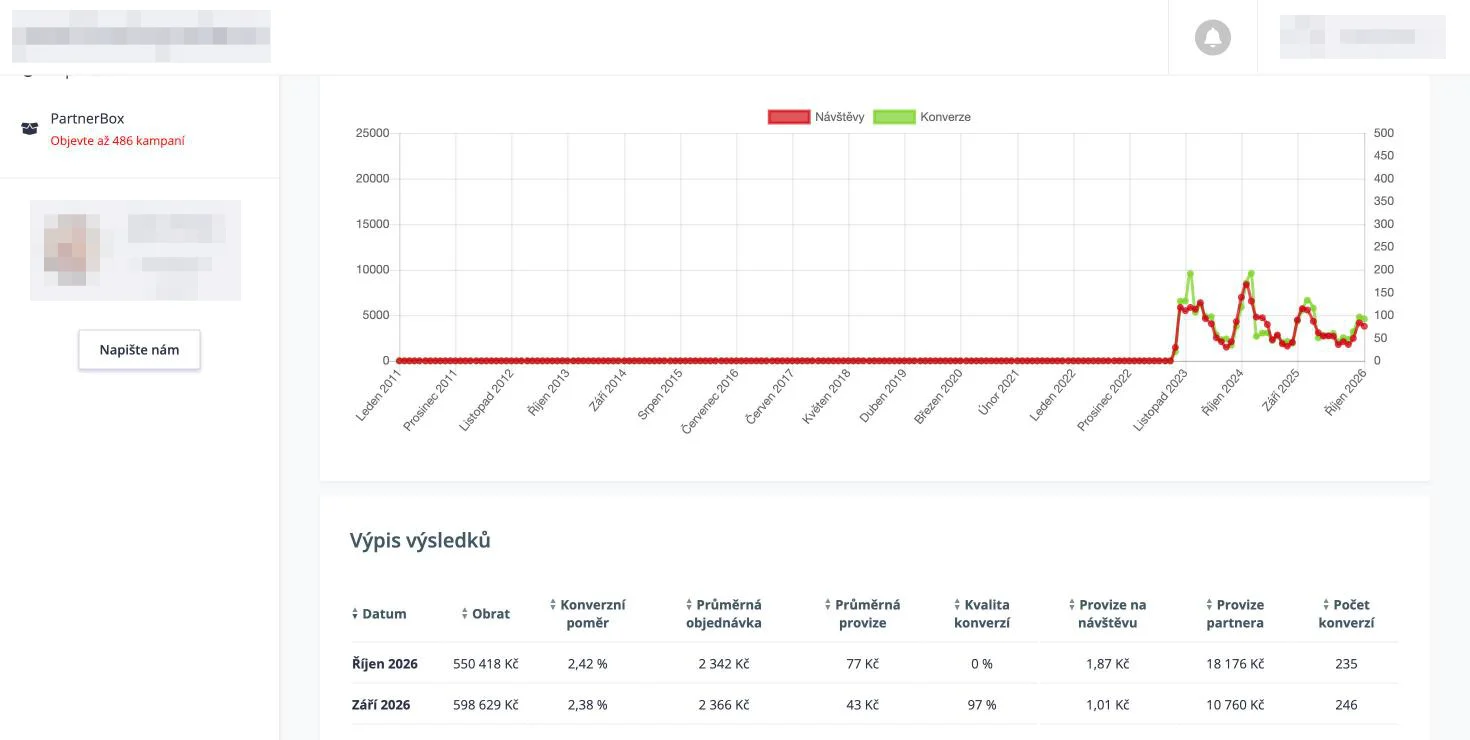
I did not pick the ticket shop from a catalogue. It sold exactly what I wrote about, and my readers were buying tickets there anyway, just not through my link. Its partner programme was nothing new, either: according to the chart in the panel it has been running since 2011. I only joined in the summer of 2023, and the first conversion came in September 2023. For twelve years, then, I sent readers to buy tickets for free, simply because I never properly looked for a partner programme.
The criteria that decided it
Thematic fit with the content. A reader who finishes an article about a specific performance is one step from buying a ticket. I do not have to persuade them to go; the article did that. I only need to show them where to buy.
Commission against order value. The programme pays 3% of the order value, classic CPS. Three percent impresses nobody, but the average order is what counts: people buy tickets in twos and fours, often for several events at once, so the average order across the whole period works out at roughly CZK 2,000 to 2,400. Three percent of that is around sixty crowns per order, and 7,922 orders add up to half a million. Always work out how many crowns one typical order brings you, not how many percent the programme page promises.
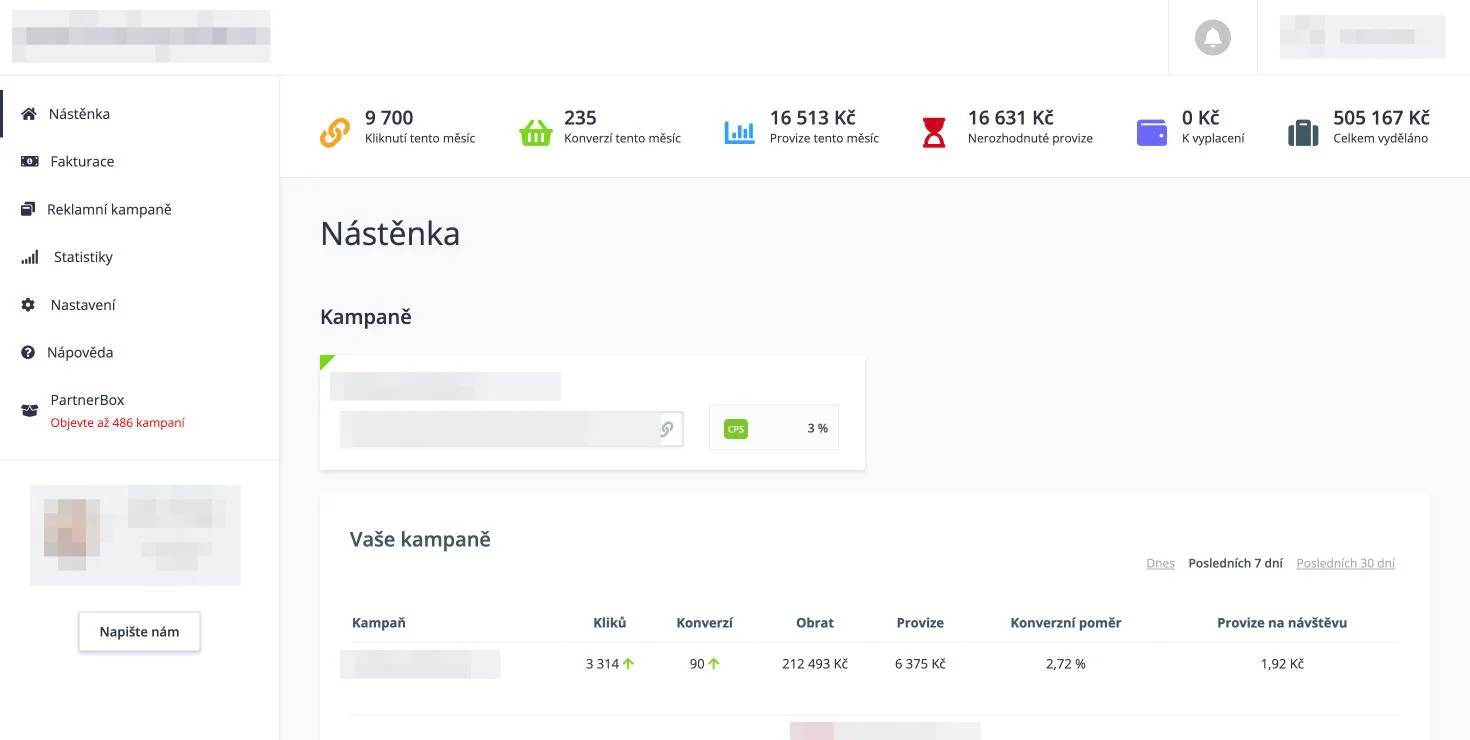
How approval works. With tickets, commission is approved only after the event, because until then the ticket can be refunded or the event cancelled. As I write this, the panel shows CZK 16,631 in pending commission and CZK 0 awaiting payout, because approved amounts are paid out continuously. The shop approves predictably, which in a long-term relationship is worth more than speed.
A person on the other side. When I ask something, a specific affiliate manager answers, someone who knows what is coming up. Several times I was told about a presale start in advance, so the article was live the moment people began searching for it.
What worked
Articles about specific events
The best converters are articles about one specific event: what it is, who performs, who it is for, when and where it takes place and what tickets cost. I write them ahead of time, ideally as the presale opens, and then let them work. Some are earning for the third season running, because the performance returns and all the article needed was new dates.
Date overviews
The second pillar is overview pages: what is on this month, what is coming in autumn, what to buy as a gift. These pages need the most ongoing work, because dates change, but in return they bring the most stable traffic.
Links in the text instead of banners
A link in the text, exactly where the reader is looking for ticket information, converts incomparably better than any banner. What works is a sentence along the lines of "tickets from X crowns are on presale here", with the link going directly to the event page in the shop, never to the homepage. Deep links are essential with tickets: someone looking for a particular concert will not browse the shop's catalogue. Across the whole period the click-to-order conversion rate stays roughly between 2 and 3.5%, respectable for a content site without discount codes.
Updating old articles
An article about last year's performance has authority, backlinks and history with search engines. When the event returns, you add the date, update prices, rewrite the introduction and check that the link still points to the right page. That update takes half an hour and the article earns again.
Newsletter
I send the newsletter irregularly, driven by what is coming up rather than by the calendar. Subscribers are the most loyal part of the audience, and before Christmas the newsletter sells the most. A gift tip with a ticket link, sent in the first week of Advent, brings in more than the whole summer combined, and the monthly figures below bear that out.
What did not work
Banners. The shop offers graphic banners in several formats. I put them in the sidebar and under articles. They produced a fraction of the orders and made the site uglier. A banner knows nothing about the context of the article; a link in the text does.
Discount codes without context. For a few months I tried a page listing the shop's discount offers. It was visited by people who had already decided to buy and were just looking for a discount; the commission from them was luck, not the result of my work. A code works as part of a recommendation; as a standalone page it was a parasite on the brand.
Generic articles. Pieces like "how to choose a gift for a culture lover" looked good on paper. They brought traffic but almost no orders. A generic article makes sense as an entry point with links to specific events, not as a direct source of commission.
Promotion off topic. I also tried the ticket link on a site that only touched the subject. The result was zero, and it confirmed that thematic fit is not just a nice phrase.
Figures over time
The following figures come from the partner panel as of 25 October 2026.
By year
| Year | Commission | Orders | Revenue generated |
|---|---|---|---|
| 2023 (September to December) | CZK 48,323 | 1,213 | CZK 2,711,391 |
| 2024 | CZK 212,757 | 2,984 | CZK 6,257,208 |
| 2025 | CZK 148,892 | 2,157 | CZK 4,797,388 |
| 2026 (to 25 October) | CZK 92,195 | 1,568 | CZK 3,608,368 |
| Total | CZK 502,167 | 7,922 | CZK 17,374,355 |
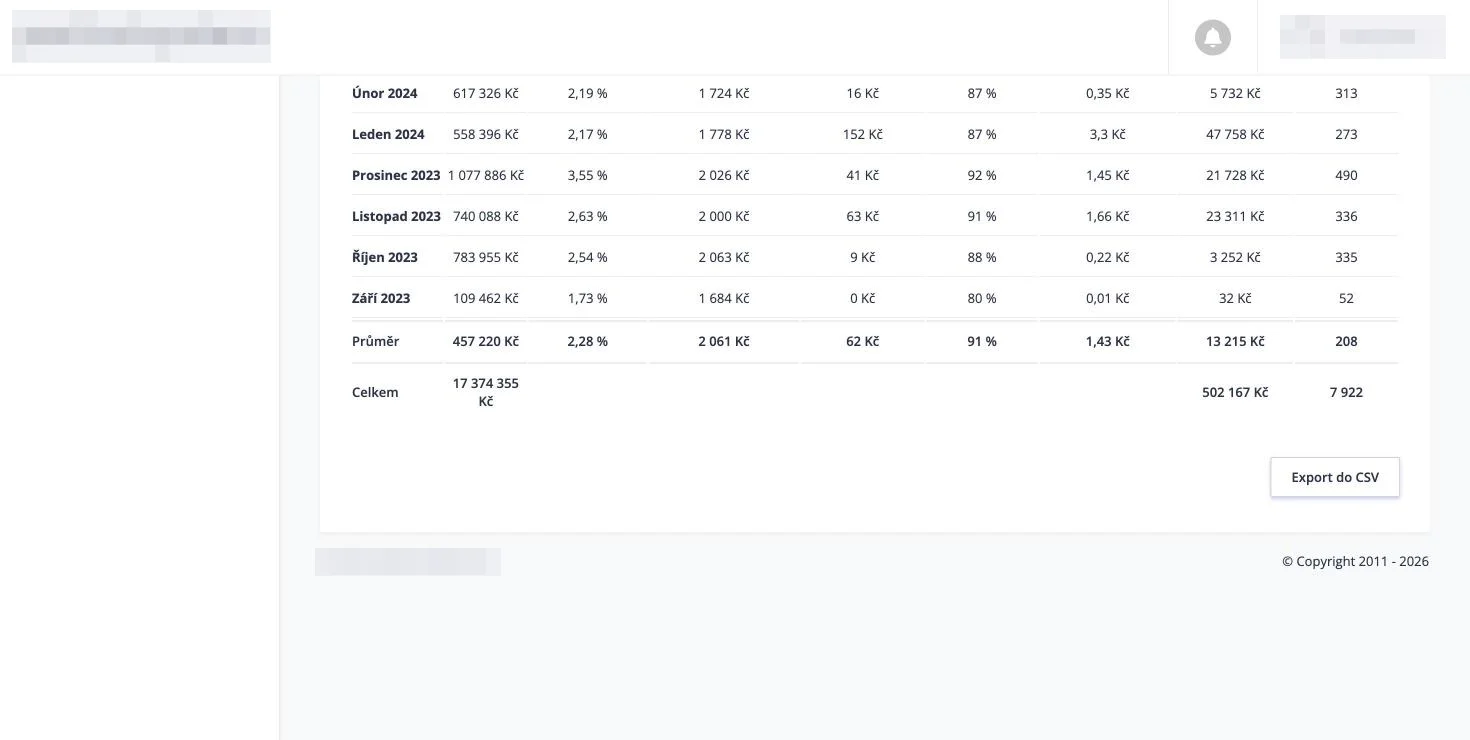
Three things in the table deserve attention. The fast start: the first four months alone brought over 48 thousand, because I rolled the programme out on sites that already had readers and hundreds of articles. The peak in 2024: CZK 212,757 and almost three thousand orders. And the drop in 2025 to CZK 148,892, roughly a third; 2026 brought CZK 92,195 up to 25 October. Part of the decline I put down to spending less time on the sites than in 2024, part to changes in search that most content sites felt around then; I do not know the exact split. Even the weaker years are six-figure sums from a single programme.
Strongest and weakest months
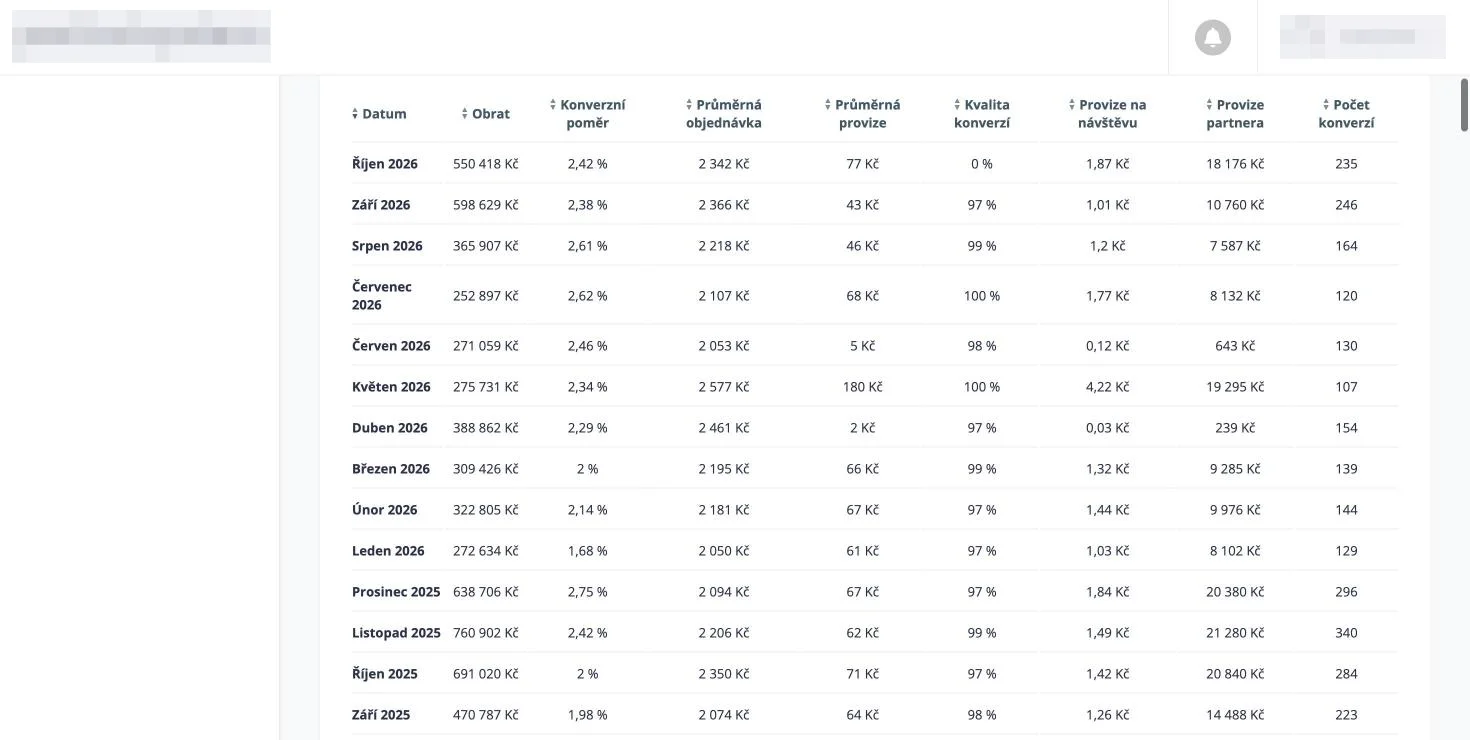
Seasonality with tickets is not a theory. The strongest month of the whole period was January 2024 with CZK 47,758, almost a quarter of the entire 2024 commission in a single month. It is followed by December 2024 (CZK 31,020), November 2024 (CZK 27,084), November 2023 (CZK 23,311), December 2023 (CZK 21,728), November 2025 (CZK 21,280), October 2025 (CZK 20,840), October 2024 (CZK 20,532) and December 2025 (CZK 20,380). The only outliers in the top ten are May 2026 (CZK 19,295) and October 2026, which stands at CZK 18,176 on the 25th and is not over yet.
At the other end are August 2024 with CZK 5,432, February 2024 with CZK 5,732 and August 2025 with CZK 5,907. The difference between the best and the worst month is almost ninefold. October to January form the core of the year: Christmas gifts, Advent concerts, New Year presales. Summer is weak, because theatres are on holiday and people are thinking about their own holidays, not culture.
Months with revenue but no commission
The panel contains months in which my links generated hundreds of thousands of crowns in revenue and the commission on it was close to zero. April 2026: revenue CZK 388,862, commission CZK 239. June 2026: revenue CZK 271,059, commission CZK 643. And right at the start, October 2023: revenue CZK 783,955, commission CZK 3,252, when three percent of that revenue would have been over 23 thousand.
Why part of the orders carry zero commission is something I could not read from the panel. They may be categories the programme does not pay on, events by organisers with different terms, cancelled performances or something else entirely; I do not know and I do not want to guess. The lesson, though, is clear and applies to every programme: do not count on revenue, count on approved commission. Check the panel every month, not once a year when you invoice, and when you see a month that stands out, write to the affiliate manager and ask.
This month
For October 2026 up to the 25th, the panel dashboard shows 9,700 clicks, 235 orders and CZK 16,513 in commission (the monthly table says CZK 18,176; each report apparently counts a different set of orders). The last seven days: 3,314 clicks, 90 orders, revenue CZK 212,493, commission CZK 6,375, which means a conversion rate of 2.72% and CZK 1.92 in commission for every visit to the shop.
Risks and lessons
Half a million from one programme sounds good, but it has a downside.
Dependence on one programme. If the shop closed the programme tomorrow, I would lose most of the affiliate income from these sites at once. Focusing on one programme is a bet, not diversification.
A decline you do not see in time. Between 2024 and 2025 a third of the commission disappeared. I only noticed at the annual total, because monthly swings with tickets are so large that the trend hides behind them. Compare a month with the same month of the previous year, not with the previous month.
Changes in terms. The commission, cookie length or excluded categories can change in an email that is easy to miss. Today I would want someone watching those terms for me.
Seasonality and cash flow. Four strong months a year, four average, four weak, plus approval only after the event. Money from pre-Christmas sales largely arrives in spring. A publisher who wants to live on this needs a second programme with the opposite season, or a reserve.
What I would do differently
I would join earlier. The programme has been running since 2011; I received my first commission in September 2023. The visits and conversions chart in the panel is a flat zero until autumn 2023, and in every one of those years I was sending readers to buy tickets. If you write about something that sells, check today whether the seller has a partner programme.
I would deal with zero commission immediately. October 2023, with revenue of over three quarters of a million and commission of three thousand, should have been the signal to write to the affiliate manager. Instead I enjoyed November and forgot about October.
I would keep records by event, not only by month. The panel tells me how much I earned in November 2024, but not which article or which performance brought it in, and that is exactly what I would need to know when planning the next season.
How to find and follow a programme like this on AffilPlanet
When I started, finding a programme outside the networks meant hunting for a "Partner programme" link in a shop's footer and hoping. That is why the programme catalogue on AffilPlanet lists, alongside network programmes, the in-house programmes of shops that you will not find in any network. For each one you see the network or in-house system, the commission rate and type, the cookie length, the countries and the category, so the criteria from this article can be checked in a few minutes.
Filter by the category that matches your content and go through the programmes one by one. For each, answer four questions: does it fit the topic, how many crowns does a typical order bring, how and when is commission approved and who is behind the programme. A programme managed directly by the shop carries a "Verified" badge, and you can message the affiliate manager straight from the programme page.
You can follow a programme and receive a notification when the commission, terms or codes change, which solves the overlooked email. And in your publisher account you record monthly revenue and commission for each programme you promote and see a chart across all of them. Had I done that from the start, April 2026 with CZK 239 in commission would have jumped out immediately rather than six months later. Publisher registration is free at /registrace, and what the account can do is described on the page for publishers.